
























Teleoperation
Leader–follower and joystick demonstrations. Each episode is split into task and subtask phases, with the points where an attempt stalls or fails marked.
Teleoperation, egocentric and robot-side video, segmented, captioned and graded by teams trained on motion rather than still images. We work inside your platform, under your spec, and send back the cases your guide doesn't cover in week one. Need the footage captured first? We collect it too.
A wrist camera loses the object at the moment of contact. A head camera sees both hands but not the grip. We learn where each source goes wrong before we write a single boundary.
Leader–follower and joystick demonstrations. Each episode is split into task and subtask phases, with the points where an attempt stalls or fails marked.
Head-mounted fisheye plus left- and right-wrist views, read together. One caption has to hold across all three streams and join up with the segments before and after it.
End-effector-centric demonstrations captured without a robot in the scene: phase boundaries read from gripper open and close, not from a joint trace.
Factory assembly lines, kitchens, back yards; not staged sets. Actions overlap, pause and restart, and half of each call is deciding which action is the task.
Instance masks for the parts an industrial robot has to find and pick: mixed hardware in bins, parts on trays and lines. Every object gets its own outline and class, and touching or partly hidden parts are split apart.
Multi-frame LiDAR sequences labeled against three orthographic views, with 2D–3D fusion, merged frames and a separate pass for missed objects.
We recruit operators and participants, run the sessions and hand back episodes already labeled under your spec. One contract and one set of acceptance rules, from the first recording to the last label.
Task list, scenes, camera placement, what counts as a success, and how many takes per task, agreed with your team.
Participant releases and location consent for homes and workplaces, filed per episode before footage leaves the site.
Operator, scene and device recorded for each episode; stream sync checked before the session ends, not after delivery.
Idle, blurred or off-task footage is flagged before labeling, then episodes are annotated and delivered to your storage.
When does a grasp start? Which stream is the boundary read from? Is a failed attempt followed by a recovery one episode or two? Those calls decide whether “object enters gripper” means anything to your model.
Your guide defines these. Every time, it also leaves some of them undefined: the frame a grasp starts on, whether a recovered failure counts once or twice, whether the instruction describes intent or outcome.
We hit those gaps in week one and ask, instead of guessing them for forty thousand items.
Task and subtask boundaries, read against every synced stream, with the source stream recorded.
A caption or instruction per segment, at the coverage you set: every segment, or a stated share such as 70%.
Which object, where it sits, what it's made of, what gets picked first.
Invalid actions, attempts blocked by the environment, and the point where an attempt goes wrong.
A quality call on every clip, so unusable footage never reaches your training set.
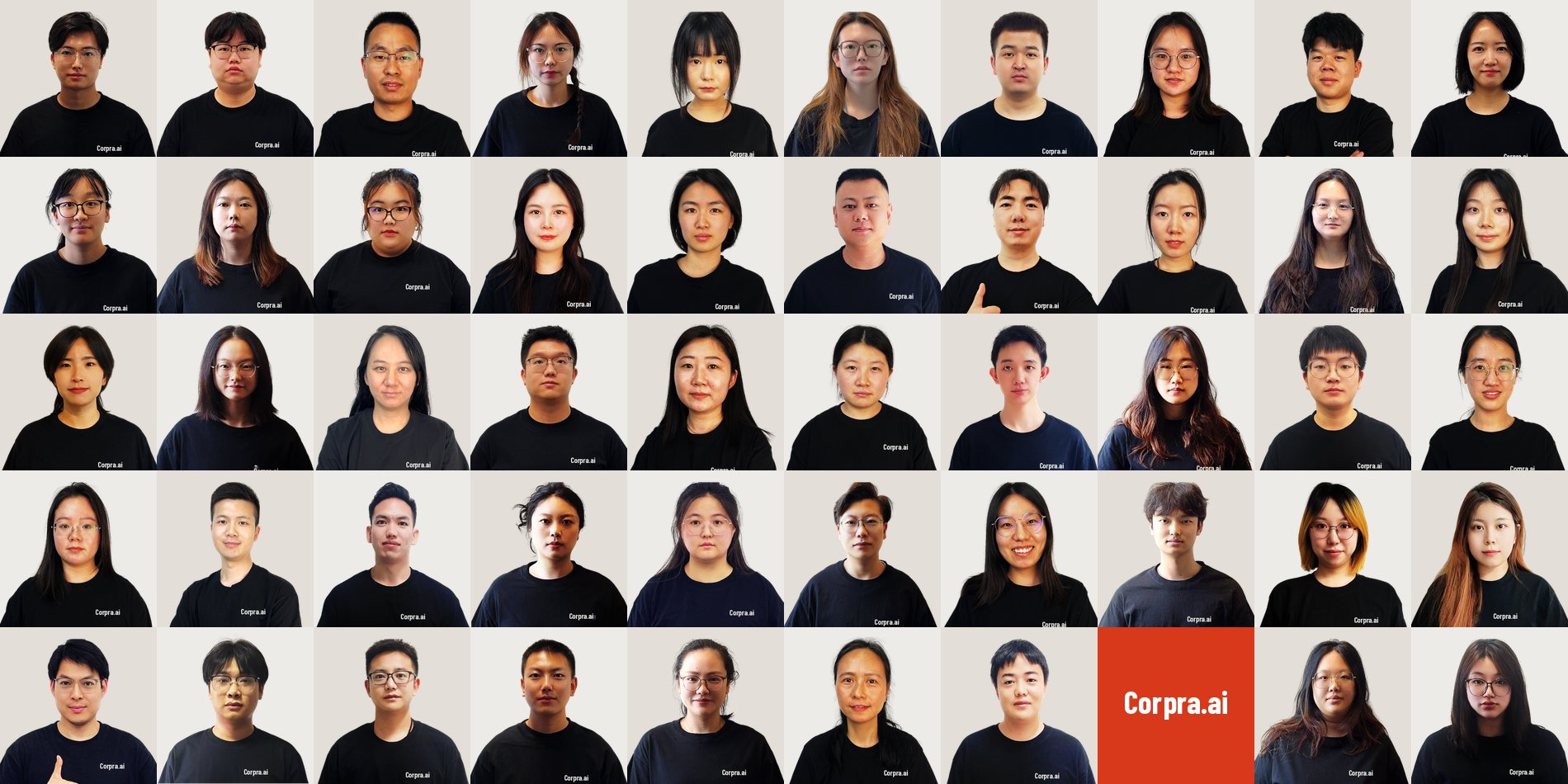
Every face here is a Corpra project manager or QA reviewer. They set up your guide, review every item and sign off each batch before it ships.
The guide splits segments at “each new action”. When the left hand steadies a box while the right hand fills it, is the steadying hand its own segment?
RulingSteadying is context, not a segment; only the acting hand opens one. Added to the guide as §3.4 and sent back to you as a diff.
A decision made once in a chat thread is invisible to whoever labels the next thousand clips. Ours go into the guide the same day.
Labelbox, Encord, CVAT or your in-house tool. Nothing to migrate, no new vendor tool for your engineers to learn.
Undefined cases come back to you as written questions during the first batch, not as rework at item forty thousand.
Under 5% segment-level error on your acceptance sampling by week 2, starting from a spec we've never seen. One wrong boundary fails the whole segment.
Annotator, then a QA manager with 2+ years of labeling who reviews every item, then a project manager with QA experience who samples.
Managed delivery centres under a Canadian contract. The location is agreed at scoping and written into the SOW, so you can show it to your own customers.
A calibration batch against your gold set, with the acceptance threshold agreed in writing before anyone scales.
We've run this two-stage loop for years: rapid iteration with your engineers on small batches, then scaled delivery once the requirement stops moving.
We read the guide end to end and send back the questions it raises before labeling starts.
100+ clips scored against your gold set. Every ruling written into the guide.
Segment-level error on your acceptance sampling under the agreed line, typically 5%. Batches below it are reworked at our cost.
Volume ramps against your delivery schedule; 25% spot checks and 2-day turnaround on returns continue.
Data captured in real homes and workplaces carries privacy obligations from the first clip. We have been through this review before: a Japanese automaker's compliance team approved cross-border sharing after we de-identified faces and plates and showed our certification.
The people who sign your contract are the people who read your spec, send the week-one questions and sign off the acceptance threshold. Between them: investment banking, venture capital, and engineering on sensors and chips.
Peter spent years in investment banking at Morgan Stanley, then in venture capital, before founding the company in 2017. He leads Corpra as CEO.
Eudora worked for years at Bosch as an engineer on sensors and chip manufacturing, then invested in manufacturing companies in venture capital. She brings that high-end manufacturing background to how Corpra runs delivery.
Several proofs of concept ran in parallel, and each needed collect, label, train and update-the-instructions in one or two days. Hiring a local labeling team would have eaten the round. We set up a dedicated team with its own QA and project lead on long-term continuous annotation.
Local rules kept faces and plates in the country. We de-identified the footage and our ISO 27001 certification satisfied the compliance team, which approved sharing. The team had never written labeling instructions, so our on-site consultant drafted and calibrated them alongside their engineers.
Each move meant retraining from zero on harder rules. Physical AI specs change every quarter; you need a team that has learned new rules before, not one that only knows the current ones.
One dimension: time.
3D space plus time: point clouds, fusion, traffic lights and signs.
Synced streams plus cause and effect in motion.
Does a grasp start at contact, or when the gripper begins to close?
Is a failed attempt followed by a recovery one segment or two?
Does the caption describe what the operator meant, or what happened?
A neutral checklist for robotics data teams, with a printable sign-off sheet. Nothing in it requires us.
Yes. We run capture to your protocol and label it under the same spec, or annotate footage you already have in the tool you already use. We don't build data-cleaning or conversion pipelines.
Labelbox, Encord, CVAT and in-house tools. We adapt to your review flow, including multi-round accept and reject.
Per segment. If any boundary or label in a segment is wrong, the segment counts as an error.
In our managed delivery centres. The location is agreed at scoping and written into the SOW.
A project lead in your time zone replies within 1 business day with the questions your guide raises and a batch plan.